
Applied Research Methods for Decision-Making
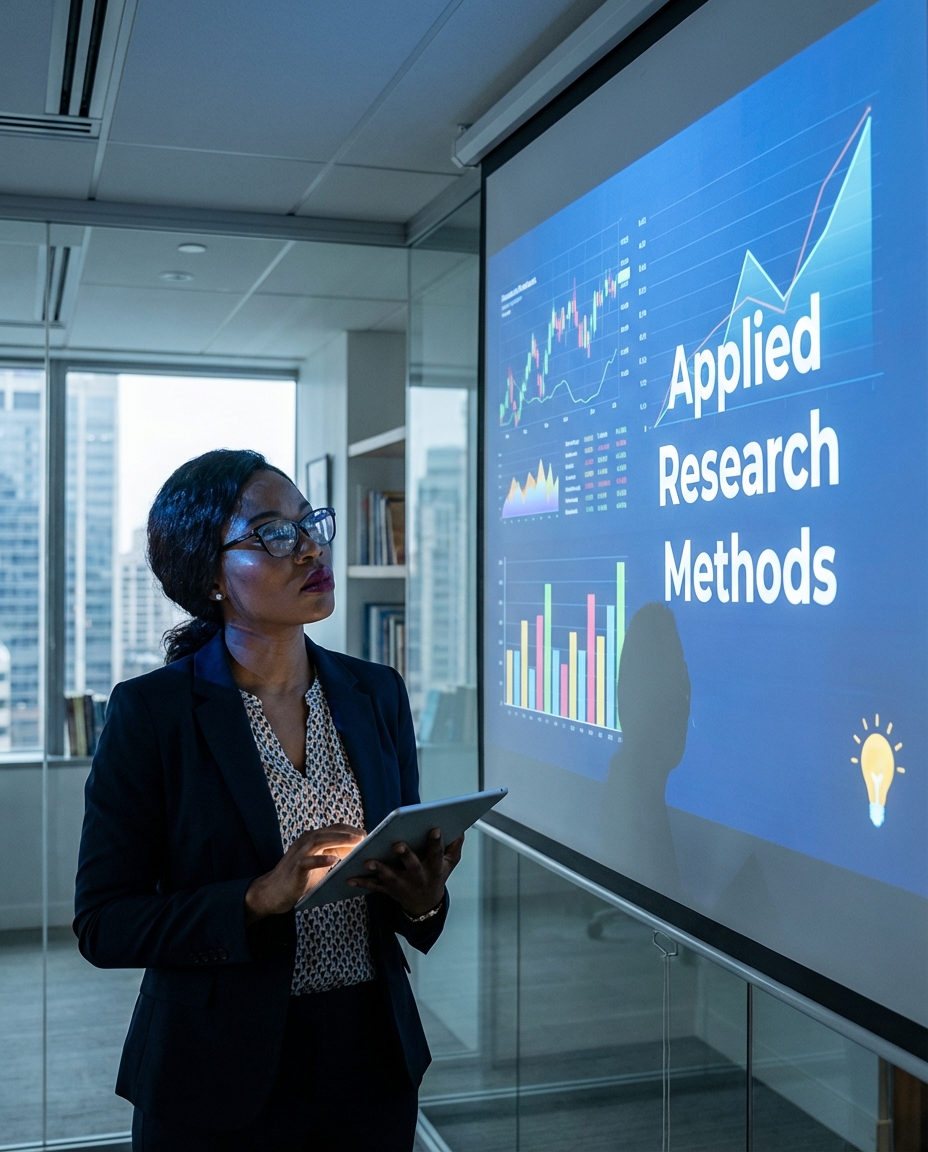
APPLIED RESEARCH METHODS FOR DECISION-MAKING
RATIONALE In the high-stakes world of business and governance, intuition is no longer enough. Leaders are constantly bombarded with conflicting data, and the cost of making the wrong choice is higher than ever. Applied research methods for decision-making serve as the critical filter that separates noise from signal. It is not just about gathering information; it is about gathering the right information to solve specific problems.
Many organizations suffer from “data rich, insight poor” syndrome. They have access to metrics but lack the methodological rigor to interpret them correctly. This leads to biased conclusions and wasted resources. To thrive, decision-makers must transition from reactive guessing to proactive, evidence-based strategy.
This training programme bridges the gap between academic rigor and practical application. It empowers participants to design and execute research frameworks that directly inform strategic choices, ensuring that every decision is backed by solid, defensible evidence.
OVERALL OBJECTIVES By the end of the programme, participants will be able to:
-
specific research methodologies to real-world business and policy problems.
-
Design robust data collection instruments that minimize bias.
-
Analyze quantitative and qualitative data to extract actionable insights.
-
Translate complex research findings into clear recommendations for stakeholders.
-
Evaluate the reliability and validity of third-party research and data sources.
-
Use research to forecast trends and mitigate risks in decision-making.
COURSE CONTENT
Day One: Research in the Context of Decision-Making
-
The role of evidence in modern leadership and strategy
-
Defining the problem: converting business issues into research questions
-
Exploratory vs. Conclusive research designs
-
Understanding the limitations and ethics of applied research
-
Stakeholder analysis: knowing who needs the data and why
Day Two: Quantitative Methods and Data Strategy
-
Survey design fundamentals: writing questions that get honest answers
-
Sampling techniques: ensuring your data represents reality
-
leveraging secondary data and big data analytics
-
Introduction to key statistical concepts for non-statisticians
-
Using A/B testing and experiments for business decisions
Day Three: Qualitative Methods and Consumer Insights
-
The power of “Why”: Deep diving with interviews and focus groups
-
Observational research and ethnographic methods
-
Analyzing text and sentiment: listening to the voice of the customer
-
Case study analysis as a decision-support tool
-
Synthesizing qualitative data with quantitative metrics
Day Four: From Analysis to Insight
-
Data cleaning and preparation best practices
-
Interpreting correlation, causation, and significance
-
Identifying patterns, trends, and anomalies in data sets
-
Using decision matrices and scoring models
-
Visualizing data to tell a compelling story
Day Five: Reporting and Implementation
-
Structuring the executive summary and policy brief
-
Presenting bad news: how to deliver negative findings constructively
-
Creating an action plan based on research outcomes
-
Monitoring and evaluating the impact of decisions made
-
Group project presentation: Solving a live case study
METHODOLOGY The training will be delivered using interactive and practice-oriented learning approaches, including:
-
Expert-led presentations
-
Hands-on workshops with statistical tools
-
Real-world decision-making simulations
-
Group critiques of research proposals
-
Experience-sharing sessions
TARGET AUDIENCE This programme is suitable for:
-
Senior executives and board members
-
Policy advisors and government officials
-
Product managers and strategy directors
-
Marketing and consumer insight professionals
-
M&E specialists and research consultants
MODE OF ASSESSMENT Participants will be assessed through:
-
Development of a research decision framework
-
Practical data interpretation exercises
-
Final presentation of a research-backed proposal
-
Certificates of participation will be issued upon successful completion.
FEES Training fees are charged per participant and are inclusive of:
-
Training materials
-
Resource documentation
-
Certificate of participation
-
Refreshments (where applicable)
-
Detailed fee structure available upon request.
VENUE The programme can be delivered at:
-
AYU GLOBAL–approved training centres
-
Client-designated venues
-
Virtual or hybrid platforms, where applicable
DATE To be scheduled in consultation with participating organizations.
DURATION Five (5) Days
CAPABILITY STATEMENT AYU GLOBAL INTERNATIONAL is a leading management and capacity development consulting firm with expertise in:
-
Applied research and evidence-based policy
-
Strategic decision support and analytics
-
Organizational performance improvement
-
Institutional capacity building
-
Strategic leadership and project management
The firm has successfully delivered training and advisory services to government institutions, regulatory agencies, private sector organizations, and development partners.
FACULTY / RESOURCE PERSONS The programme will be facilitated by seasoned professionals with expertise in:
-
Advanced research methodologies
-
Business intelligence and analytics
-
Strategic management and policy formulation
-
Behavioral economics
-
Data visualization and reporting
CONCLUSION The ability to conduct and utilize applied research methods for decision-making is a competitive superpower. This programme equips leaders with the tools to navigate uncertainty with confidence, ensuring that their organizations move forward based on facts, not assumptions. AYU GLOBAL INTERNATIONAL is committed to raising the standard of strategic thinking in your organization.
Instructor

You May Like

AI for Business Decision-Making and Automation
Give your leadership team the power of "super-speed" decision-making. Scale your output without scaling your headcount.
Introduction to Artificial Intelligence and Applications
RATIONALE Artificial Intelligence is the defining technology of the 21st century, impacting every sector from healthcare to finance. Understanding Artificial Intelligence applications is essential for...

Digital Transformation Strategy and Implementation
We cover the roadmap for legacy system migration, digital culture adoption, and customer experience innovation. Transform or die.

Fundamentals of Planning, Research and Data Analysis
FUNDAMENTALS OF PLANNING, RESEARCH AND DATA ANALYSIS RATIONALE In the information age, data is the new currency. However, raw data is useless without the skills...
Strategic Planning and Organizational Development
STRATEGIC PLANNING AND ORGANIZATIONAL DEVELOPMENT RATIONALE In a volatile economic landscape, a static business plan is a liability. True resilience comes from dynamic strategic planning...